
In today’s competitive hospitality market, SEO for hotels is no longer optional; it’s essential for driving direct bookings and increasing organic traffic.
With travelers relying heavily on search engines to discover and compare accommodations, your hotel’s online visibility directly impacts revenue.
A well-executed SEO strategy helps reduce dependence on OTAs while attracting high-intent guests. In fact, over 70% of travelers begin their booking journey on search engines, making optimization critical.
In this blog, we’ll go deeper into practical SEO strategies that help you drive direct bookings and grow organic traffic. If you’re new to the topic or want a refresher on the fundamentals, we’ve already covered the basics of hotel SEO in detail in our other guide.
Now, let’s focus on how to apply those principles and turn them into real results.
What Is Hotel SEO and Why It Matters
Hotel SEO (search engine optimization) is the process of improving your hotel website so it shows up higher in search results on Google and other search engines. The goal is simple: help more people find your hotel when they search online.
What Hotel SEO Includes
- Using the right keywords on your website
- Optimizing pages like rooms, location, and amenities
- Improving website speed and mobile experience
- Getting links from other trusted websites
Why Hotel SEO Matters
Most travelers start their journey online. If your hotel does not appear in search results, you miss out on potential guests.
Here’s why it’s important:
- More visibility: Higher rankings mean more people see your hotel
- More direct bookings: Guests book directly instead of through OTAs
- Lower costs: You reduce commission fees from third-party platforms
- Better trust: Hotels that rank higher often seem more reliable
How SEO Impacts Direct Booking and Visibility
When your hotel shows up in the top search results, you attract travelers who are ready to book. This leads to more website visits, more inquiries, and more direct revenue.
In short, hotel SEO helps you get found, stay competitive, and grow your bookings without relying only on paid channels.
Hotel SEO Strategies
A strong hotel SEO strategy helps you turn online searches into real bookings. It’s not just about ranking higher, it’s about bringing the right guests to your website and giving them a smooth experience.
Building a Successful Hotel SEO Strategy
To build an effective strategy, your SEO efforts should focus on both visibility and usability. Start with the basics:
- Keyword research: Find what your guests are searching for and use those terms across your site
- Content optimization: Create helpful pages for rooms, amenities, and local attractions
- Technical setup: Make sure your website loads fast and works well on mobile
- Local SEO: Optimize for location-based searches like “hotel near city center”
But ranking alone isn’t enough. Your strategy should also aim to increase website traffic that actually converts. That means attracting users who are ready to book, not just browse.
Aligning SEO Strategies with Booking Goals
Your SEO efforts should always support your main goal: more direct bookings. This means connecting search visibility with a strong user experience.
- Clear booking paths: Make it easy for visitors to find and complete a booking
- Relevant landing pages: Match search intent with the right page (e.g., “family hotel” → family room page)
- Trust signals: Use reviews, photos, and clear pricing to build confidence
- Simple navigation: Help users move through your site without confusion
A good user experience keeps visitors on your site longer and increases the chance they will book. When your SEO strategy brings in the right website traffic and your site makes booking easy, you get better results from every visit.
💡Shining the Spotlight
To take your user experience even further, it’s worth shining the spotlight on tools that remove friction from the guest journey, like the HotelSync Guest App.
With features such as self-check-in, guests can skip the front desk and start their stay faster, creating a smoother arrival experience. At the same time, built-in upselling options allow you to offer room upgrades, add-ons, or services directly through the app.
Keyword & SEO Keywords
Keywords are the foundation of every successful SEO strategy in the hotel industry. They connect what travelers are searching for with what your hotel offers. But effective keyword use is not just about adding popular terms, it’s about matching intent, structuring your content, and guiding users toward booking.
A strong keyword strategy helps you attract the right audience, improve rankings, and increase conversions. It also supports other SEO elements like your meta description, page content, and internal links, all of which work together to improve visibility and user experience.
How to Find the Right Hotel SEO Keywords
Finding the right keywords starts with understanding how your potential guests search.
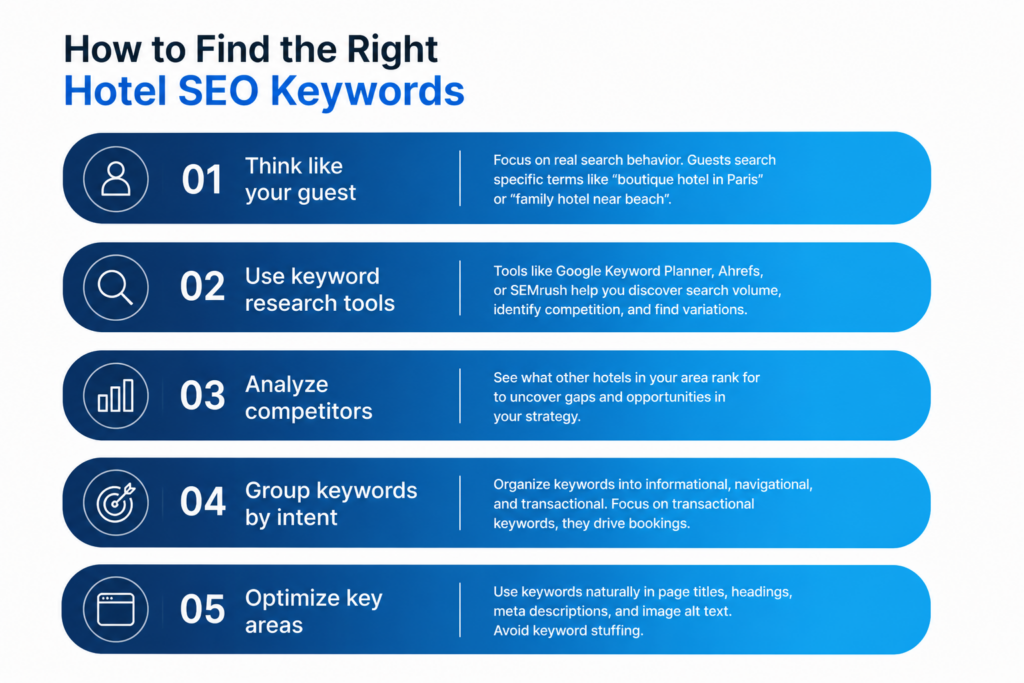
1. Think like your guest
Focus on real search behavior. Guests don’t search for “luxury accommodation solutions”, they search for:
- “boutique hotel in Paris”
- “family hotel near beach”
- “pet-friendly hotel in Berlin”
2. Use keyword research tools
Tools like Google Keyword Planner, Ahrefs, or SEMrush can help you:
- Discover search volume
- Identify competition levels
- Find keyword variations
3. Analyze competitors
Look at what other hotels in your area rank for. This can reveal gaps and opportunities in your own strategy.
4. Group keywords by intent
Not all keywords are equal. Organize them into:
- Informational: “best time to visit Rome”
- Navigational: hotel brand searches
- Transactional: “book hotel in Rome”
Focus heavily on transactional keywords, they drive bookings.
5. Optimize key areas
Once selected, use keywords naturally in:
- Page titles
- Headings
- Meta description
- Image alt text
Avoid keyword stuffing, Google prioritizes clarity and relevance.
Using Hotel SEO Keywords to Target the Right Audience
Choosing keywords is only half the job, how you use them determines results.
1. Match keywords to specific pages
Each page should target a clear keyword:
- Homepage → broad terms (e.g., “hotel in Barcelona”)
- Room pages → specific offerings (e.g., “deluxe sea view room”)
- Blog content → informational searches
2. Write for humans first
Your content should feel natural and helpful. Keywords should fit into sentences without forcing them.
3. Optimize your meta description
Your meta description is what users see in search results. A strong one:
- Includes your main keyword
- Highlights value (location, price, amenities)
- Encourages clicks
Example:
“Stay at our beachfront hotel in Split. Enjoy modern rooms, sea views, and easy online booking.”
4. Use internal links strategically
Internal links help both users and search engines:
- Guide visitors to relevant pages (e.g., blog → booking page)
- Improve site structure
- Spread SEO value across your website
For example, a blog about “things to do in Dubrovnik” should link to your room or booking page.
5. Align content with guest needs
Your keywords should reflect what your ideal guest wants, location, experience, or price. This ensures your traffic is more likely to convert.
Long-Tail Keywords like “Hotel Near” Searches
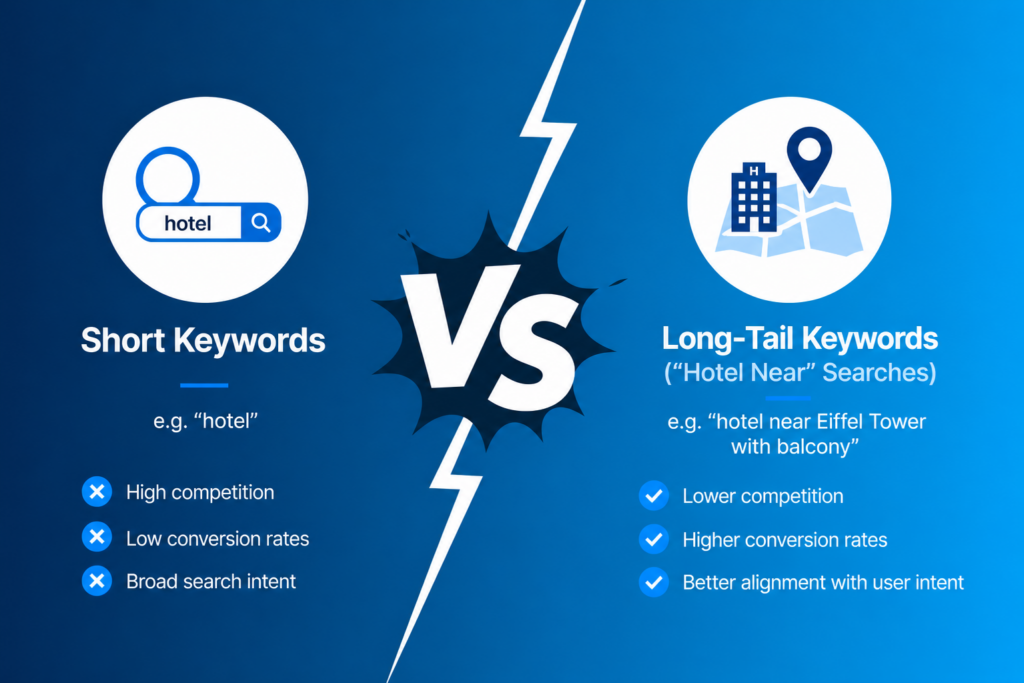
Long-tail keywords are more specific phrases, and they are extremely valuable in the hotel industry.
Examples:
- “hotel near Eiffel Tower with balcony”
- “budget hotel near city center Rome”
- “hotel near airport with shuttle service”
Why they matter:
- Lower competition
- Higher conversion rates
- Better alignment with user intent
How to use them effectively:
1. Create dedicated pages
Instead of one generic page, create content targeting specific searches:
- “Hotel near Old Town Dubrovnik”
- “Hotel near Belgrade Arena”
2. Optimize for local intent
Include:
- Nearby landmarks
- Neighborhood names
- Travel distances
This improves relevance for “near me” and location-based searches.
3. Use them in blog content
Write helpful articles like:
- “Best hotels near Colosseum”
- “Where to stay near city center”
Then connect them with internal links to your booking pages.
4. Add them naturally to your content
Use long-tail keywords in:
- Headings
- Paragraphs
- Meta description
But keep the flow natural, clarity always comes first.
Local SEO for Hotels
Local SEO is a key part of any effective SEO strategy in the hotel industry. It helps your property appear in location-based searches, especially when travelers look for places nearby. In this complete guide to hotel SEO, mastering local visibility is essential for attracting high-intent guests.
Google Business Profile & Local Listings Optimization
Your Google Business Profile is one of the most important tools for local SEO.
- Keep your profile complete and up to date
- Add high-quality photos of rooms and amenities
- Collect and respond to guest reviews
- Ensure your hotel name, address, and phone number are consistent across all listings
Accurate and optimized listings improve trust, boost visibility, and support a more effective SEO presence overall.
On-Page & Off-Page SEO
To improve your hotel’s visibility online, you need both strong on-page and off-page SEO. One helps search engines understand your website, while the other builds trust and credibility beyond it.
On-Page SEO Best Practices for Hotel Websites
On-page SEO is everything you control on your site, and it plays a big role in how easily both users and search engines navigate your content.
1. Structure pages with clear intent
Each page should focus on one topic. For example, your rooms, amenities, and location pages should all serve different purposes. This makes it easier for search engines to match your pages with the right queries.
2. Use headings to guide readers
Well-structured headings (H1, H2, H3) make your content easier to scan. This improves readability and helps search engines better understand your content.
3. Make visuals work for SEO
Images are essential for hotel websites, but they should also be optimized:
- Use descriptive file names
- Add alt text that explains the image
- Keep file sizes small for faster loading
4. Keep users engaged
A good user experience keeps visitors on your site longer. Use clear calls-to-action, simple layouts, and easy-to-read content to guide users toward booking.
Off-Page SEO: Backlinks and Authority Building
Off-page SEO focuses on how your hotel is perceived across the web.
1. Build quality backlinks
Links from trusted websites signal that your hotel is credible. Focus on getting featured in travel blogs, local guides, and tourism websites.
2. Strengthen your online reputation
Guest reviews influence both trust and visibility. Encourage reviews and respond to them regularly to show that you value feedback.
3. Maintain consistent listings
Make sure your hotel details are accurate across all platforms. Consistency helps search engines trust your business information.
4. Use partnerships and PR
Collaborate with local businesses or promote unique experiences to get mentioned in articles or guides. These mentions can drive traffic and improve your authority over time.
A balanced approach to on-page and off-page SEO helps your hotel stand out, build trust, and attract more potential guests.
Ranking, Visibility & Organic Traffic
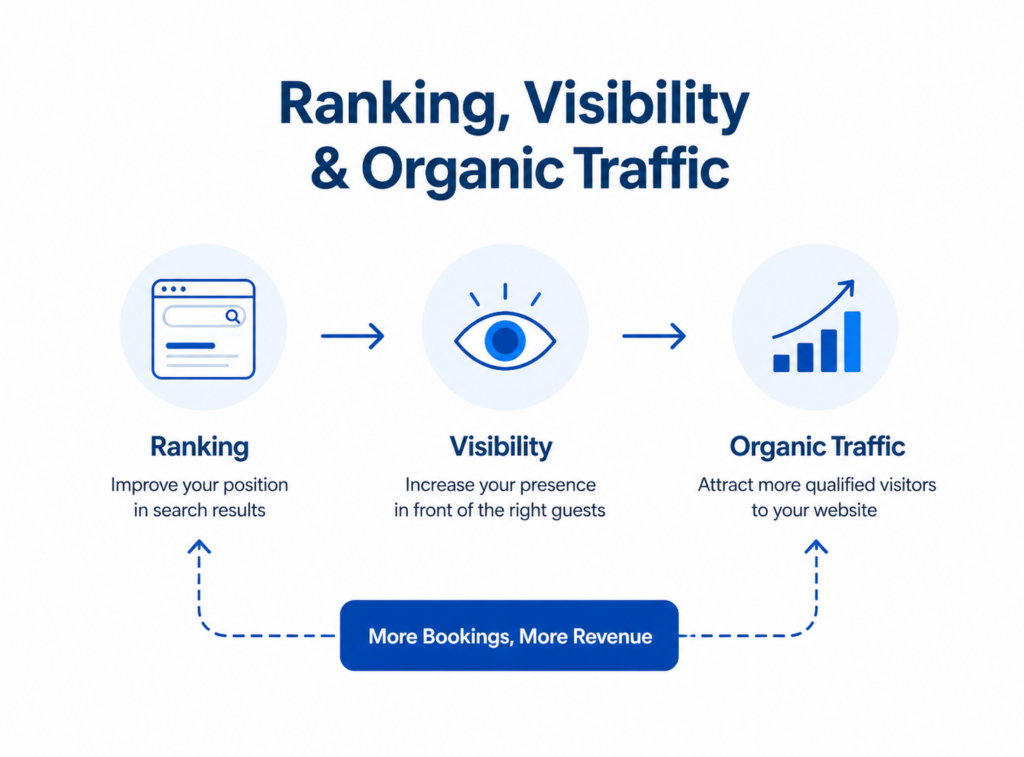
If your hotel website is already live, the goal is no longer just to “be online”, it’s to improve how well it performs. That means increasing your position in search results, getting more qualified visitors, and turning that traffic into bookings. Small, consistent improvements can make a big difference over time.
How to Improve Ranking on Search Engines
If your rankings have plateaued, focus on refining what you already have instead of starting from scratch.
1. Refresh existing content
Go back to your key pages and update them:
- Add more useful details (amenities, nearby attractions, FAQs)
- Improve clarity and structure
- Keep information current
Search engines favor updated, relevant content.
2. Identify underperforming pages
Use tools like Google Search Console to find pages that:
- Rank on page 2 or 3
- Get impressions but low clicks
These are your biggest opportunities, small improvements can push them higher.
3. Improve internal linking
Connect your pages better:
- Link blog content to booking-related pages
- Guide users toward high-value pages
This helps search engines understand your site and improves navigation.
4. Optimize for local search intent
If you’re not ranking well locally, refine your location signals:
- Add more context about your area
- Mention nearby landmarks naturally
- Keep your business information consistent
This strengthens your presence in local search results.
Increasing Visibility and Organic Traffic for Hotels
Once your rankings improve, the next step is to grow traffic that actually converts.
1. Expand with targeted content marketing
Don’t just rely on core pages. Create useful content like:
- Local guides
- Travel tips
- Seasonal recommendations
This brings in users earlier in their journey and builds long-term organic search visibility.
2. Focus on click-through rate (CTR)
If your pages appear in search but aren’t getting clicks:
- Rewrite titles to be more compelling
- Make descriptions clearer and more benefit-driven
Better messaging can increase traffic without changing rankings.
3. Improve user behavior signals
If visitors leave quickly, rankings can drop. To keep users engaged:
- Make content easy to scan
- Highlight key information early
- Ensure fast load times
The longer users stay, the stronger your performance in organic search.
4. Track and adjust regularly
SEO is not one-time work. Monitor:
- Traffic trends
- Keyword positions
- Conversion rates
Then adjust your approach based on what’s working.
Direct Booking & Booking Optimization
Driving direct bookings should be the main goal of your SEO marketing efforts. It is not enough to bring traffic to your hotel’s website. You need to turn that traffic into real reservations.
Start by making the booking process as simple as possible. Visitors should be able to find your booking engine quickly and complete a reservation without confusion. At the same time, your content needs to match what users are searching for. Clear calls-to-action, strong visuals, and relevant information all help guide users toward booking.
Your content management system also plays a key role here. It allows you to update offers, adjust landing pages, and keep your website fresh. When your content stays relevant, users are more likely to trust your hotel and complete a booking.
💡Shining the Spotlight
To take your direct booking strategy even further, we are shining the spotlight on the HotelSync Booking Engine. Designed to seamlessly adapt to your hotel’s website, it blends naturally into your existing design without disrupting the user experience.
What makes it especially powerful is its connection to the HotelSync PMS and Channel Manager. This means your availability, rates, and bookings are always in sync across all platforms. Instead of being just a tool, it acts as a fully integrated sales channel, helping you capture more direct bookings while keeping everything centralized and easy to manage.
Measuring Hotel SEO Performance
To understand if your SEO marketing is working, you need to track performance consistently. Focus on how your hotel’s website is performing in search results and how users behave once they arrive.
Look at trends in organic traffic, changes in keyword rankings, and how many visitors actually convert into bookings. These insights show whether your strategy is attracting the right audience and whether your website is doing its job.
Instead of chasing every metric, focus on the ones that directly impact revenue. This makes it easier to identify what needs improvement and where to invest your efforts.
Tools to Track SEO Success
The right tools help you turn data into action. Platforms like Google Analytics and Google Search Console give you a clear view of how users find and interact with your hotel’s website.
They show which pages attract traffic, where users drop off, and which keywords bring visibility. More advanced SEO tools can then help you refine your strategy by identifying gaps and new opportunities.
Many content management systems also include built-in insights or integrations, which makes it easier to update content and track performance in one place.
When you combine strong SEO marketing with consistent tracking, your hotel’s website becomes more than just an online presence. It becomes a reliable source of direct bookings.
Common Hotel SEO Mistakes
Even with a solid marketing strategy, small SEO mistakes can limit your results. Many hotels invest time and effort into optimization but fail to see growth because they focus on the wrong things or overlook key areas. The truth is, SEO isn’t about quick fixes. It is about consistency, relevance, and creating a strong experience for your website visitors.
Keyword Stuffing and Poor Optimization
One of the most common mistakes is overusing keywords in an attempt to rank higher. SEO isn’t about repeating the same phrase over and over. This often makes content hard to read and can actually hurt your rankings.
Instead, focus on writing naturally. Your content should sound helpful and clear, not forced. Search engines are now smart enough to understand context, so it is better to use variations of keywords and focus on quality.
Poor optimization can also show up in other ways, such as unclear page structure, weak headings, or missing key elements like titles and descriptions. All of this affects how both search engines and website visitors understand your content.
Hotel SEO Tips
Improving your SEO does not always require a complete overhaul. The most effective hotel SEO marketing strategies combine quick improvements with long-term consistency. By focusing on both, you can see faster results while building a strong foundation for future growth.
Quick Wins to Improve SEO Today
If you want to see immediate improvements, start with small changes that have a direct impact.
Update your website content on key pages. Make sure your homepage, room pages, and main landing pages clearly explain what you offer and who it is for. Even small updates can improve relevance and visibility.
Review your page titles and descriptions. These are often overlooked, but they play a big role in whether users click on your site. Clear, compelling messaging can increase traffic without changing your rankings.
Check your technical SEO basics. Ensure your website loads quickly, works smoothly on mobile devices, and has no broken links. Fixing these issues improves both user experience and search performance.
Finally, make sure your most important pages are easy to access. If users struggle to find your booking page, you are likely losing potential reservations.
Long-Term SEO Growth Strategies
Long-term success in hotel SEO marketing comes from consistency and continuous improvement.
Invest in high-quality website content that answers real questions your guests have. This can include local guides, travel tips, or detailed information about your property. Over time, this builds authority and attracts steady organic traffic.
Strengthen your technical SEO over time by regularly auditing your site. As your website grows, maintaining speed, structure, and performance becomes even more important.
Focus on building a strong content strategy rather than publishing randomly. Each piece of content should have a purpose and support your overall goals, whether that is attracting new visitors or guiding them toward booking.
Lastly, track your performance and adapt. SEO is always evolving, and what works today may need to be refined tomorrow. Consistent optimization is what turns short-term gains into long-term growth.
How HotelSync Can Help
A strong hotel SEO marketing strategy brings traffic to your hotel’s website, but the real value comes from converting that traffic into direct bookings. HotelSync helps you do exactly that by connecting all key systems into one platform.
With an integrated Booking Engine, your website becomes a powerful sales channel, allowing guests to book directly without friction. At the same time, the PMS and Channel Manager keep your rates, availability, and reservations fully synchronized across all platforms.
HotelSync also enhances the guest experience with features like payments and a Guest App, supporting smoother booking, communication, and upselling opportunities.
Because everything is connected, you get clear insights into performance and can better align your SEO efforts with real results. This means more efficient operations, improved user experience, and more direct bookings from the traffic you already have.
🚨Special Offer
Want to stay on top of things and receive special offers and discounts? We’ve got you!
HotelSync rewards smart hoteliers by giving out special discounts. To receive yours, click HERE!
 English
 Deutsch
 Français
 Hrvatski
 Srpski
 Crnogorski
 Italiano
 Español
 简体中文
简体中文 Magyar
 Português
 Română
 Русский
 Shqip
Shqip Nederlands
 Ελληνικά
 العربية
 Български