
Yield management is a smart way for hotels to earn more money by selling the right room to the right guest at the right time — and for the right price.
It started with airlines, like American Airlines, to help them set better prices for seats. Today, hotels employ a similar strategy to boost their profits by adjusting prices in response to demand. In fact, the market for hotel revenue tools could grow from $100 billion in 2023 to $221.8 billion by 2030.
In this guide, you’ll learn what yield management is, why it matters, and how to use it in your hotel.
Let’s dive right in.
What is Yield Management?
Yield management for hotels is a pricing strategy that allows hotels to adjust their prices based on various factors. This can help maximize revenue by changing prices to meet demand and seasonality.
Thinking about hotel rooms as perishable might not be conventional, but it’s a very good analogy. Once a date passes and a room is not filled, it hasn’t made money. Hence, hotel rooms have expiry dates of sorts.
Using yield management is not only about making sure all rooms are booked. It’s also about forecasting high demand and offering a more competitive price. Hotels can increase revenue by adjusting their prices based on:
- Seasonality (High VS Low Season where demand highly varies)
- First and Last Minute Offers (Booking Trends)
- Room Types
- Events in the Area
These changes need to be made in real-time since a spike in demand can be a short wave to ride. A popular band announcing a tour stop in your city demands a quick reaction from the revenue manager. The quicker they are to adjust the prices of rooms, the better the chances are that they will optimize revenue for this period.
What is the Difference Between Yield Management and Revenue Management?
Yield management is a part of revenue management that focuses specifically on optimizing pricing and inventory for perishable products like hotel rooms, while revenue management takes a broader view — looking at all revenue streams, costs, and profit optimization.
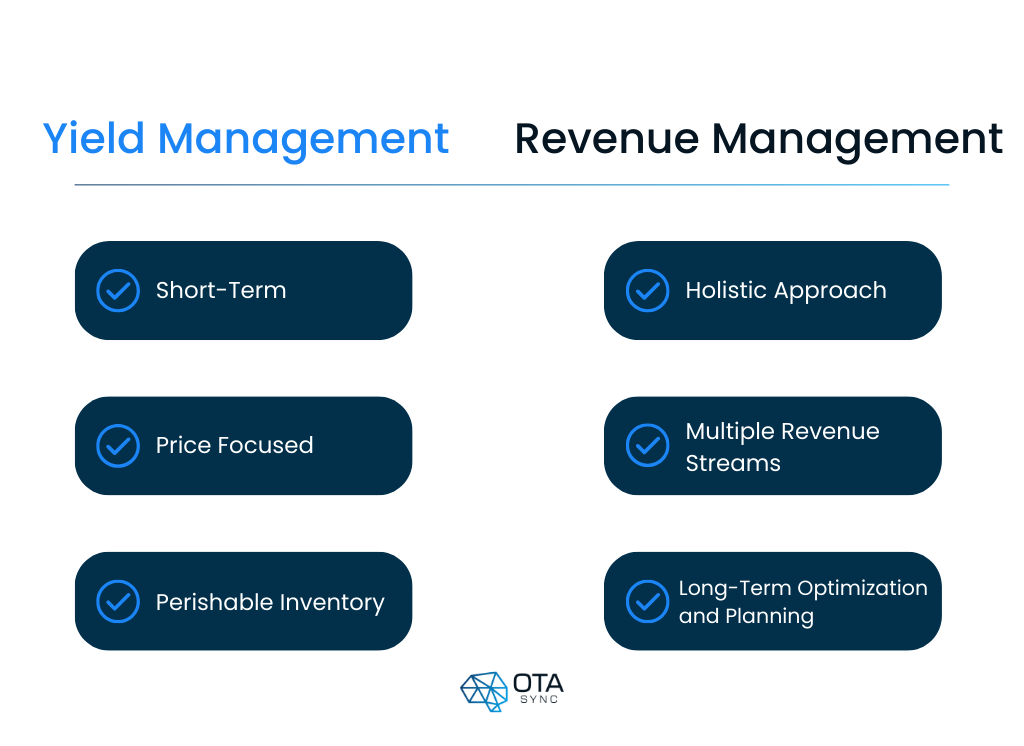
While they are closely related, they differ in a few main points. Yielding considers only room prices, while revenue management plans on additional revenue streams like upselling, ancillary services, and channel mix.
In short, yield management is a tactical pricing tool while revenue management is a strategic revenue system.
Yield Management VS Dynamic Pricing
Yield Management isn’t only about demand forecasting. It also involves creating some limitations to the booking. Sometimes, you might want to make your bookings limited to a minimal number of nights. This means the guest can only book, for instance, for 3 or 2 nights.
Sometimes your bookings might be non-refundable, for example, before and during New Year’s Eve. This is all a part of yield management.
Dynamic pricing is a practice of creating your prices based on daily demand. In an ideal world, your hotel would have a static price rate. During high season, your rooms would have higher prices, and during low season, slightly less.
Since this way you could lose possible revenue, you would implement dynamic pricing.
Main differences:
- Different Core Mechanisms- Yield management optimizes revenue by controlling inventory and pricing over time, while dynamic pricing adjusts prices in real time based on demand and market factors.
- Real-Time vs. Pre-Planned Adjustments- Yield management uses pre-set pricing tiers based on forecast demand, while dynamic pricing adjusts instantly using real-time data.
- Tech Dependency- Dynamic pricing relies heavily on AI and real-time analytics, while yield management can be more manual, relying on historical data, but is increasingly tech-enhanced.
Real-Life Examples of Yield Management
Recently, we have checked in with one of our clients in Croatia. In a beautiful resort in Vodice, Fabiano has his guests coming back time and time again.
Are special amenities or a specific location keeping his accommodation full? Or is the ease of using the right technology to yield their prices?
Fabiano shows us how a good revenue management system can be crucial to keep the resort going. You can read in detail about how Matilde Beach Resort implements dynamic pricing in our blog.
Or watch it in the video below.
Why is Yield Management Important in Hospitality?
Yield management is crucial in hospitality because it helps businesses maximize inventory management, especially perishable items like hotel rooms, which can’t be sold after a given date. It enables hotels to charge the right price to the right customer at the right time, balancing supply and demand throughout the booking cycle.
Implementing yield management creates amazing benefits like:
- Boosts RevPAR(Revenue per Available Room), a key performance metric.
- Allows pricing to respond to market trends
- Attracts different customer segments(early birds VS late bookers)
- Helps with staffing, amenities, and operational planning.
Key Elements of an Effective Yield Management System
An effective yield management system relies on data, strategy, and tools that work together to optimize revenue. To choose the best tool for your hotel, look for these key elements:
- Accurate Demand Forecasting- Uses historical data, external factors, and seasonal patterns to predict demand.
- Segmentation of Customers- Groups customers based on behavior, booking habits, or willingness to pay (e.g., business vs. leisure travelers).
- Dynamic Pricing Strategy- Sets flexible pricing rules based on occupancy levels, booking windows, and market demand.
- Inventory Control- Allocate the right number of rooms to different price tiers or sales channels.
- Real-time Data and Updates- Continuously monitors market conditions, competitor pricing, and booking pace.
- Integration with PMS and Channel Managers- A good system connects seamlessly with your Property Management System (PMS) and distribution channels.
- Performance Monitoring and Reporting– Tracks KPIs like RevPAR, ADR, and occupancy to measure effectiveness.
Top Yield Management Strategies to Optimize Hotel Revenue
Effective yield management isn’t just about adjusting prices—it’s about applying the right strategies at the right time to make every room count.
1. Segment Your Market Effectively
Identify and price differently for customer types (e.g., business vs. leisure, early bookers vs. last-minute guests).
Helps target the right audience with the right rate at the right time for the right booking.
2. Use Dynamic Pricing Based on Demand
Adjust room rates in real time or at regular intervals depending on occupancy, seasonality, and events.
Avoid fixed pricing that leaves money on the table and limits the effectiveness of your revenue management strategy.
3. Implement Length-of-Stay Controls
Set minimum or maximum stay requirements during high-demand periods.
Increases revenue by optimizing room turnover and reducing single-night stays on peak dates, contributing to higher overall revenue.
4. Control Booking Channels
Allocate inventory strategically across OTAs, direct bookings, and other platforms.
Offer incentives for direct bookings to reduce commission costs and improve overall revenue performance.
5. Utilize Forecasting Tools
Use historical data and predictive analytics to anticipate demand trends.
Helps in planning, pricing, and availability well in advance, supporting a data-driven revenue management strategy.
6. Manage Overbooking Strategically
Accept slight overbooking based on expected cancellations or no-shows.
Maximizes occupancy without harming guest experience and helps protect overall revenue.
7. Monitor Competitor Pricing
Regularly track competitor rates to stay competitive without underpricing.
Use rate shopping tools to automate this process as part of a responsive revenue management strategy.
8. Promote Upselling and Cross-Selling
Train staff and set up online booking options to offer upgrades, late check-outs, or add-ons.
Boosts average revenue per guest and enhances your hotel’s overall revenue potential.
💡Shining the Spotlight
We’re shining the spotlight on OTA Sync‘s all-in-one cloud hotel system. Not only is their yield calendar unbeatable, but so are their packages.
With a PMS, Channel Manager, Booking engine, and all other tools connected into one software, adjusting prices across all channels has never been easier!
Yield Management FAQs
Definition of Yield Management
Yield management is a pricing strategy that maximizes revenue generated from a fixed, perishable inventory by offering the right product to the right customer at the right time for the right price.
What is Yield Management Pricing?
Yield management pricing involves adjusting prices based on demand, booking behavior, and timing to offer the same product to the right customer at the right time for the right price, boosting revenue generated.
Under What Type of Demand is Yield Management Most Effective?
Yield management is most effective under fluctuating or variable demand, where pricing and availability can be adjusted to match the right product to the right customer and maximize revenue generated.
Revenue Management Definition
Revenue management is a broader strategy that uses forecasting, segmentation, and dynamic pricing to deliver the right product to the right customer at the right time for the right price, with the goal of increasing total revenue generated.
How AI Can Maximize Elements of Hotel Yield Management
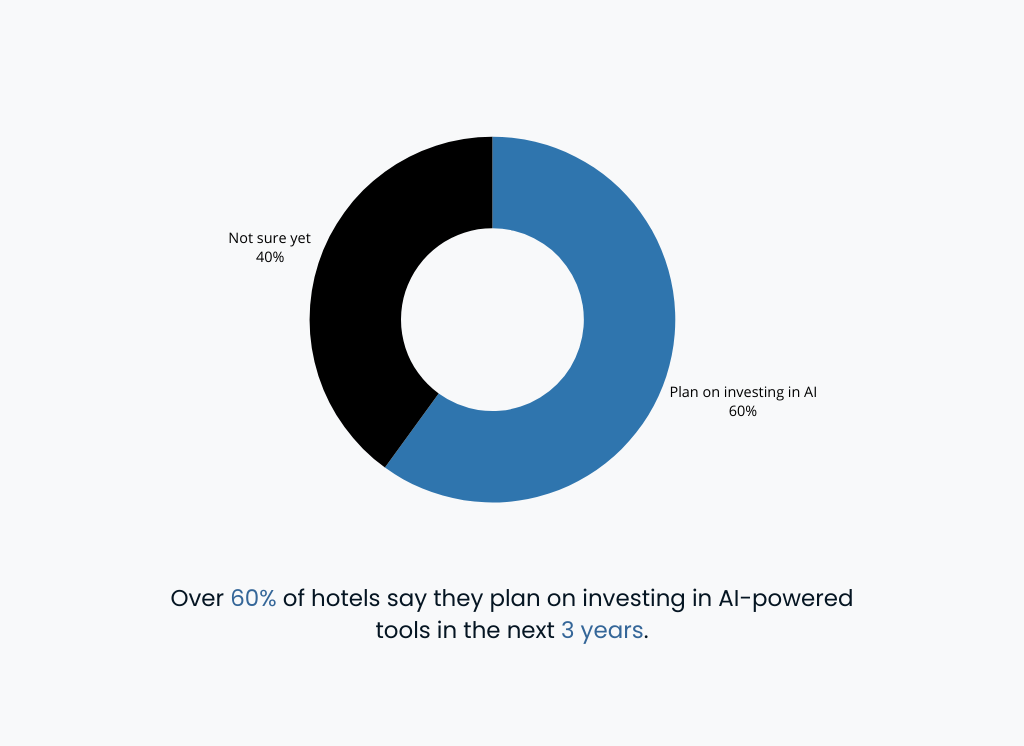
Artificial intelligence is transforming how accommodation providers fine-tune pricing and availability strategies.
By analyzing large volumes of booking patterns, guest behavior, and market trends, AI can enhance key aspects of revenue optimization—such as demand forecasting, rate adjustments, and room allocation.
This leads to smarter decision-making, improved operational efficiency, and greater income potential across all departments.
The Human Side of the Hotel Industry: Training Staff for Strategy Execution
While intelligent systems can handle complex tasks like monitoring real-time demand shifts and adjusting pricing accordingly, they still require human oversight.
Revenue professionals play a critical role in guiding these systems—setting floor and ceiling rates, reviewing automated recommendations, and ensuring strategic alignment.
Equally important, trained staff are essential for managing variables AI can’t fully account for, such as phone reservations, walk-ins, and local context. Empowering your team with the skills to interpret data and execute strategy ensures that technology works as a support system, not a replacement.
Mistakes with Yield Management in the Hospitality Industry(And How to Avoid Them)
Even experienced teams can miss the mark when it comes to successful yield management. One overlooked mistake is depending too heavily on static pricing models without adjusting for booking windows or lead times. If you’re not reviewing how far in advance different guest types tend to book, you may be setting prices too early—or too late—to capture their interest.
Another issue is ignoring small data signals, like shifts in local booking behavior or event cancellations. While AI helps with monitoring trends, it’s still the yield manager’s job to catch the details that algorithms might skip. For example, failing to adjust rates when a nearby event is suddenly postponed can leave revenue on the table.
Some hotel management teams also underuse their own direct channels. Relying mostly on OTAs can reduce control over pricing and lead to higher costs. A smarter hotel revenue management approach includes regularly reviewing performance across all sales channels and adjusting the mix based on what actually converts.
Lastly, weak capacity management—such as not protecting premium room types or overselling budget ones—can damage long-term earnings. Balancing room categories and setting limits based on forecasted demand helps avoid lost opportunities.
To avoid these missteps, yield managers should combine system insights with hands-on decision-making, review overlooked data points, and refine their strategy regularly.
Conclusion
Successful yield management is more than just changing prices—it’s about using data, tools, and teamwork to make smart choices. Even with strong AI tools, you still need people to guide the process and handle things tech can’t, like phone bookings or walk-ins.
When done right, hotel revenue management helps properties earn more money, fill more rooms, and plan better for the future. By avoiding common mistakes and training your staff, your hotel management team can stay in control and grow profits with confidence.
🚨Special Offer
Want to stay on top of things and receive special offers and discounts? We’ve got you!
OTA Sync rewards smart hoteliers by giving out special discounts. Sign up now.
 English
 Deutsch
 Français
 Hrvatski
 Srpski
 Crnogorski
 Italiano
 Español
 简体中文
简体中文 Magyar
 Português
 Română
 Русский
 Shqip
Shqip Nederlands
 Ελληνικά
 العربية
 Български