
In the world of hotel performance, understanding the adr metric is essential because it directly influences how much revenue a property generates from each stay.
A hotel adr doesn’t work in isolation; it connects closely with other key hotel metrics like occupancy rate and RevPAR, helping revenue managers understand the full picture behind revenue per available room. When optimized correctly, even small changes in ADR can significantly impact total hotel revenue and profitability.
In 2025, U.S. hotel data shows that ADR continues to grow modestly even as demand stabilizes. For example, industry reporting based on STR data shows the average daily rate in the U.S. reached approximately $160.54 in 2025, up about 0.9% year-over-year, highlighting how pricing power remains a key driver of hotel performance even in a slower growth environment.
This is why ADR is such an important hotel metric; it directly measures pricing strength per occupied room and remains one of the strongest levers for improving hotel revenue performance and overall profitability.
What is ADR in Hotels?
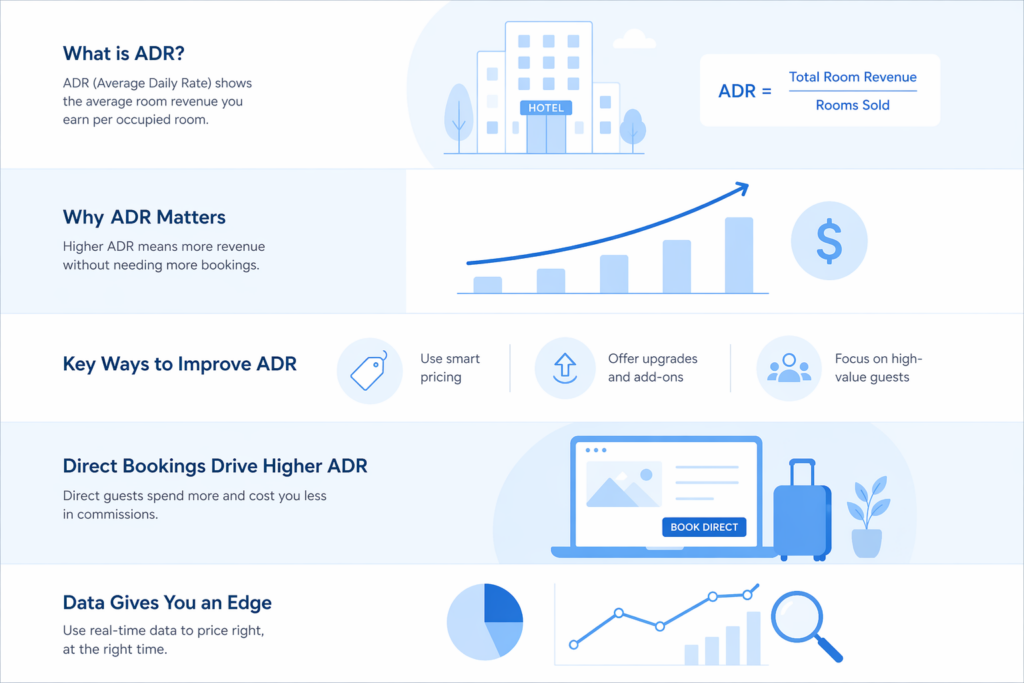
ADR (average daily rate) is a core hotel metric that shows how much revenue a hotel earns per occupied room.
It is calculated based on the room rate guests actually pay, not the total number of rooms available. In simple terms, it measures the average rate a hotel receives for each sold room.
Why ADR is Important in the Hotel Industry
In the hospitality industry, ADR helps hotels understand pricing strength and demand quality.
A strong ADR usually signals effective pricing strategies and healthy hotel revenue performance. It is widely used alongside occupancy rate and RevPAR to evaluate overall hotel performance.
What ADR Tells You
ADR shows the real income efficiency of each occupied room. It helps hotels understand whether they are earning a higher rate for the rooms they sell and whether their pricing strategy is strong enough to support revenue goals.
Understanding the ADR Metric
Why ADR is Important for Revenue Management
ADR measures the average rate earned from each occupied room over a specific period.
It does not include empty rooms, which is why it is different from broader metrics like RevPAR. It focuses purely on realized room revenue.
Tracking ADR helps hotels understand whether they are successfully applying revenue management systems and pricing strategies.
It also highlights whether they should aim for a higher ADR or focus more on occupancy.
How to Calculate ADR
ADR is calculated using a simple formula:
ADR = total room revenue ÷ number of rooms sold
This shows how much revenue per occupied room a hotel generates on average.
ADR Formula Explained
Step-by-step breakdown:
- Total Room Revenue
This is all the money earned from selling rooms in a specific time period (day, week, month). It only includes room revenue, not food, drinks, or other services. - Number of Rooms Sold (Occupied Rooms)
This is the total number of rooms that were actually booked and stayed in. Empty rooms are not included.
What the formula really means:
When you divide total hotel revenue from rooms by the number of occupied rooms, you get the average price paid per room.
For example:
- If a hotel earns €10,000 in room revenue
- And sells 50 rooms
- ADR = €10,000 ÷ 50 = €200
This means the hotel’s average rate per occupied room is €200.
ADR vs RevPAR
What is RevPAR (revenue per available room)?
RevPAR (revenue per available room) is a performance metric that shows how much revenue a hotel generates per available room, whether it is occupied or not.
It combines both average daily rate (ADR) and occupancy rate into a single figure, giving a clearer view of overall hotel performance.
RevPAR formula:
RevPAR = ADR × Occupancy Rate
or
RevPAR = Total Room Revenue ÷ Total Available Rooms
Hotel managers use it to measure how efficiently their full room inventory is producing income.
ADR and RevPAR: Key Differences
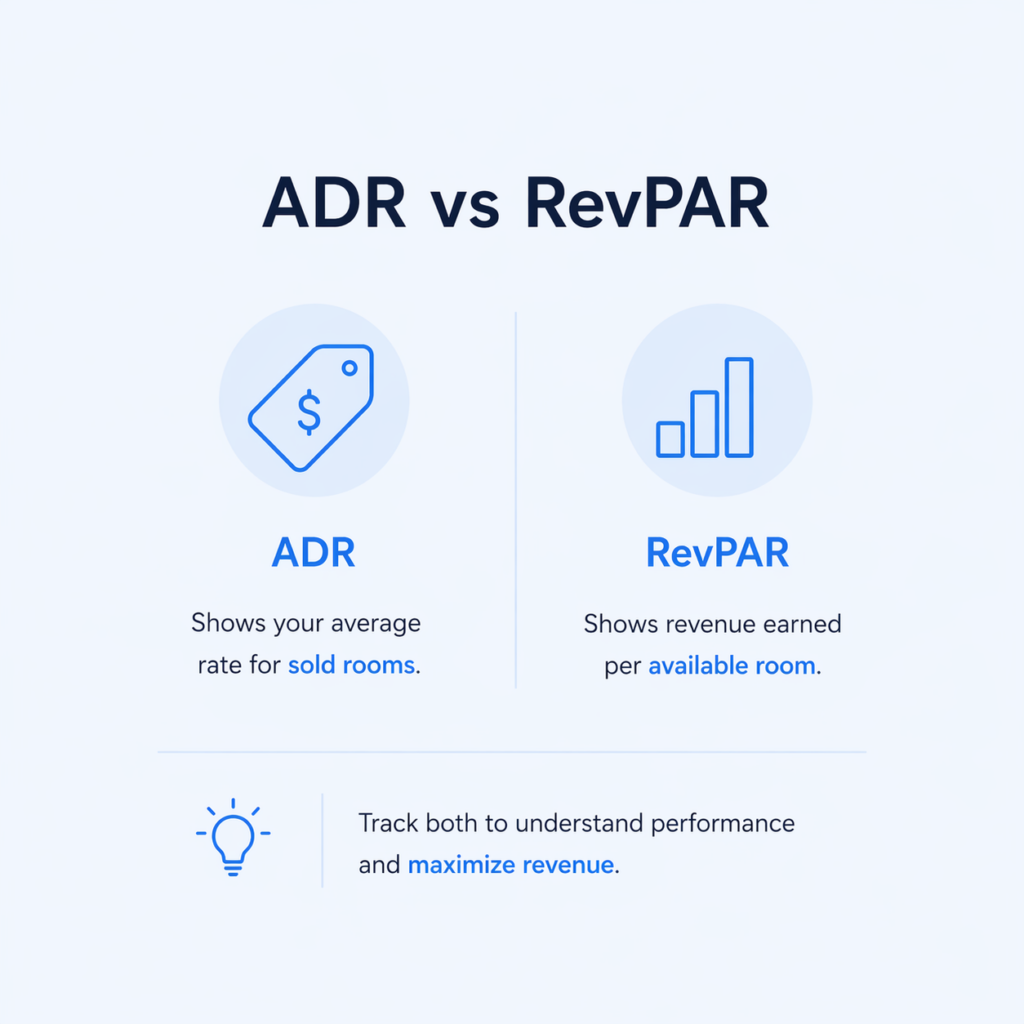
ADR measures the average rental price per occupied room, while RevPAR measures revenue per available room across the entire hotel.
ADR only looks at rooms that are sold, while RevPAR includes both sold and unsold rooms. This means ADR reflects pricing strength, while RevPAR reflects total revenue performance.
In simple terms, ADR answers “what is the room rate?” and RevPAR answers “how much revenue is the hotel actually generating overall?”
Relationship Between ADR and Revenue Per Available Room Metrics
ADR and RevPAR are directly linked.
When ADR increases, the revenue earned per occupied room increases, which can raise RevPAR if occupancy stays steady.
However, if a higher ADR reduces occupancy, total results may balance out or even drop.
This is why hotel managers closely monitor both metrics when making revenue management decisions. Together, they show how pricing and demand work together to impact total hotel income.
ADR vs Occupancy Rate
Difference Between ADR and Occupancy Rate
ADR (average daily rate) and occupancy rate measure two different parts of hotel operations.
ADR shows the average rental income per occupied room, while occupancy rate shows the percentage of rooms that are actually filled.
ADR focuses on pricing power, while occupancy focuses on demand and volume. In simple terms, ADR answers “how much do we earn per room sold?” and occupancy answers “how many rooms are we selling?”
How Occupancy Rate Affects ADR
Occupancy rate can directly influence ADR because pricing and demand are closely connected. When occupancy is high, hotels often have more pricing power and can push for a higher average rental income per room.
When occupancy is low, hotels may lower rates to attract more bookings, which can reduce ADR. This balancing act is a core part of managing room revenue by the number of occupied rooms and overall demand.
Balancing ADR and Occupancy for Profitability
For maximum profitability, hotels need to balance ADR and occupancy rather than maximize just one.
A very high ADR with low occupancy can reduce total revenue, while high occupancy with very low ADR can also limit earnings.
The goal in hotel operations is to find the optimal mix where both occupancy and ADR work together to maximize total room revenue by the number of sold rooms.
Successful revenue strategies focus on adjusting pricing dynamically to achieve the best balance between volume and rate.
Factors Affecting ADR
Key factors affecting ADR in hotels
A hotel’s ADR is shaped by a few main drivers that directly impact average revenue earned per room. Hotel revenue managers focus on these to adjust pricing and improve hotel revenue performance.
Key factors include:
- Demand levels
- Seasonality
- Pricing strategy
- Competition
- Market positioning
Small changes in any of these can quickly raise or lower ADR.
Market demand and seasonality
Demand is one of the biggest drivers of ADR.
- High demand (events, holidays, peak season) → higher ADR
- Low demand (off-season, weekdays) → lower ADR
Seasonality creates predictable ups and downs in pricing. Hotel revenue managers use this to adjust rates and protect revenue.
Pricing strategy and competition in the hotel industry
Pricing decisions directly control ADR.
- Strong demand → hotels increase rates
- Weak demand → hotels lower rates to attract bookings
In a competitive hotel industry, nearby hotels influence pricing. If competitors lower prices, ADR pressure increases.
Revenue managers use dynamic pricing tools to adjust rates in real time and protect average revenue earned while staying competitive.
How to Improve ADR
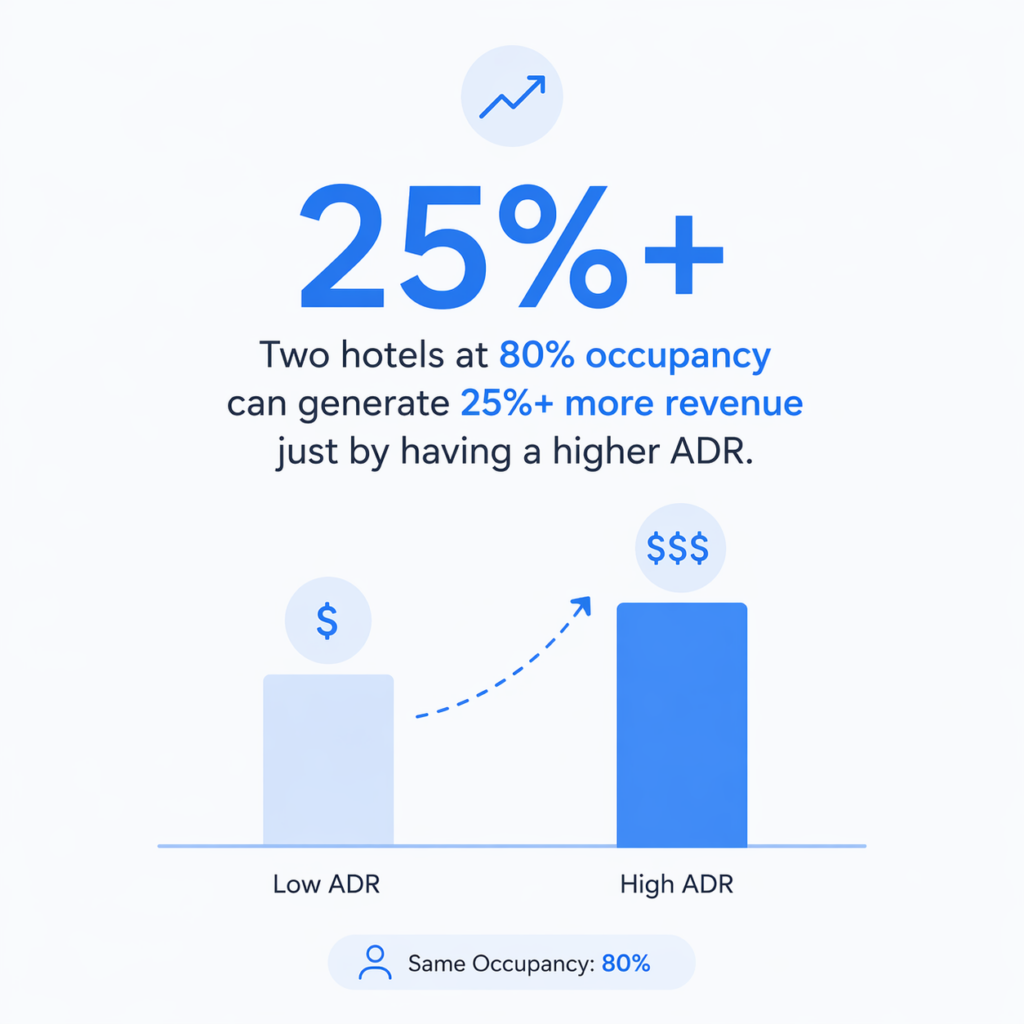
ADR is important because it directly increases your daily revenue. To improve it, focus on charging more where demand already exists instead of trying to force higher prices everywhere. Look at your top-performing dates, guest types, and channels—then push rates there first.
Strategies to Improve ADR
Start by raising prices on high-demand dates like weekends, events, and holidays. Most hotels underprice here. Then review your room types: if premium rooms sell out first, they’re too cheap. Increase those rates before touching base rooms.
You should also add simple upsells like breakfast, late check-out, or room upgrades. These don’t require new demand but still increase daily revenue per booking.
How to Increase ADR Without Losing Occupancy
Protect occupancy by controlling when and how you discount. Offer lower rates only for early bookings or longer stays, and keep last-minute inventory priced higher. This way, you fill rooms early but still capture high-paying guests later.
Also, reduce reliance on OTAs for your best rooms or peak dates. Direct guests are more likely to accept higher prices, which helps grow ADR and daily revenue at the same time.
Shining the Spotlight💡
We’re shining the spotlight on HotelSync Booking Engine. One of the fastest ways to lift ADR without hurting occupancy is to drive more direct bookings, and that’s exactly where it helps.
With full control over pricing, you can offer better packages, upsells, and rate differences than on OTAs. This means you can charge higher rates while adding value, instead of competing on price alone.
More direct bookings = higher ADR + stronger daily revenue, with lower commission costs eating into your profit.
How to Optimize ADR with Revenue Management
Revenue management means adjusting prices daily based on real demand. ADR is important because it shows if you’re pricing correctly for each night, not just filling rooms.
Using ADR in revenue management strategies
Check your booking pace every day. If rooms are selling faster than usual, raise prices immediately. If sales are slow, don’t drop prices right away, first adjust restrictions like minimum stay or close cheaper rate plans.
Also, avoid locking in low rates too early. Leave some inventory open for higher-paying last-minute demand.
How to optimize ADR with pricing tools
Use pricing tools to track competitors and demand automatically. Set rules like “increase rate when occupancy hits 70%” or “raise price when competitors sell out.” This removes guesswork and helps you react faster.
Leveraging data to increase ADR
Look at past data to find patterns. If guests always book 5–7 days before arrival, that’s where you can push higher prices. If certain days always sell out, increase rates earlier.
Track which channels and guest types bring the highest daily revenue, then prioritize them. Small, data-driven changes like this consistently lift ADR without hurting occupancy.
How HotelSync Can Help
HotelSync is an all-in-one hotel management software designed to help you run operations more efficiently while increasing ADR and daily revenue.
Since ADR is important for overall profitability, HotelSync focuses on giving hoteliers better control, clearer insights, and smarter tools across the entire booking journey.
At its core, HotelSync connects property management, booking engine, and pricing tools (etc.) in one place. This means your rates, availability, and reservations stay in sync across all channels, reducing errors and missed revenue opportunities.
On top of that, HotelSync provides real-time data and reporting, so you can track performance, understand trends, and make better pricing decisions. Instead of guessing, you’re using actual data to guide how you grow ADR over time.
Overall, HotelSync helps hotels stay organized, react faster to demand, and create a smoother guest experience, all of which contribute to stronger ADR and more consistent daily revenue.
 English
 Deutsch
 Français
 Hrvatski
 Srpski
 Crnogorski
 Italiano
 Español
 简体中文
简体中文 Magyar
 Português
 Română
 Русский
 Shqip
Shqip Nederlands
 Ελληνικά
 العربية
 Български